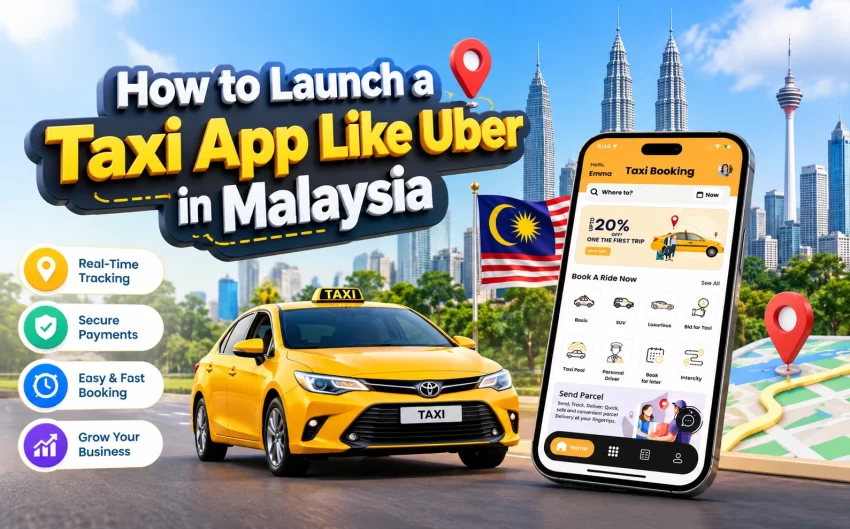
Last Updated on October 14, 2026 by esiteworld
The development of a successful taxi platform does not start with the need for a country-wide launch or for a large number of advanced features.
Sometimes, it begins with a simple local issue that needs to be solved, such as the inability to get a ride at rush hour, the need for riders to reach nearby locations through dependable transport, or businesses that require regular rides for their employees.
This provides entrepreneurs with the opportunity to create a taxi app like Uber in Malaysia based on the local travel needs rather than trying to compete with established platforms on every front.
By focusing on a particular location, developing good relationships with drivers, and designing technology that can adapt to changes over time, entrepreneurs can build a promising business in the ride-hailing business.
Find the Gap Before Building the Platform
The primary decision does not involve selecting which features are to be developed. At this stage, the objective is to conduct a study of the target market or location and identify their interests regarding the service to be offered.
A local operator can explore several business directions:
The neighbourhood mobility model
Serving community residents in reaching stores, schools, hospitals, and local transportation locations. Reliability and familiarity can become the significant distinguishing factors in the future.
The planned-journey model
This model should cover picking up riders from airports, hotels, or scheduled rides where planning in advance is required.
The business transport model
Partner with local businesses requiring employee transportation, as well as arranging the pick-up and drop-off of clients.
A local taxi app in Malaysia project should choose its initial model based on real demand from riders, the availability of drivers, and the cost of operating. Engaging in dialogue with potential clients and drivers before developing the service can show which is the most prioritized one among others.
Think Beyond the Typical Taxi App
An ordinary taxi app in Malaysia is a platform that gives riders access to taxi drivers. A good ride-hailing business also takes into account pre-trip, during-trip and post-trip processing.
| Business challenge | Practical response |
| Drivers are unavailable during busy periods | Recruit around peak demand and monitor driver coverage by zone. |
| Passengers hesitate to book | Display clear fare estimates, driver details, and arrival information. |
| Bookings are inconsistent | Develop corporate accounts and scheduled-ride services. |
| Customers do not return | Improve pickup service reliability and resolve complaints quickly. |
| Expansion becomes expensive | Track demand and operating performance before entering new areas. |
These measures make a taxi booking app in Malaysia a well-managed transport service provider, instead of just another app platform competing with others in order to attract riders.
What the first version should include
Keep the initial product focused on the essential journey:
- Registering riders and making bookings.
- Drivers getting registered and accepting bookings.
- Choosing a pick-up point and destination, along with fare estimate.
- Monitoring live location and ride status.
- Managing payments and integrating e-receipts.
- Implementing ratings, notifications, and customer support.
- Have a back-office administrator for monitoring driving activity and report generation.
Extra functionalities could be added once rider feedback and business data prove that current and future investment is reasonable.
Build Revenue Around Repeat Business
Local taxi platforms must generate consistent demand rather than just occasional bookings. Therefore, the strategy has to be to make reliable reputation with local riders who travel frequently.
Potential revenue channels include:
- Ride commissions: Keep an agreed-upon percentage of the completed fare.
- Corporate accounts: Provide businesses with organized booking and billing for transport.
- Scheduled transfers: Provide transport services to riders who need commuting at specific times.
- Premium services: Offer larger vehicles or specialised travel options where demand exists.
- Booking-related fees: Apply clearly disclosed fees to appropriate services.
For a ride-hailing business in Malaysia startup, it is essential to calculate whether revenues earned from completed rides can cover driver incentives, operational support, technological expenses, advertising, insurance, etc.
A small operating area with reliable service offered can be more profitable than a large area with service provided to riders facing many cancellations and long waiting times.
Choose a Technology Partner That Supports the Business Model
The way development decisions are made impacts how fast a business can verify its concepts and how easily it adapts to any changes in the market. While building every component on its own gives greater flexibility, it also means that this would require more time spent on development and testing.
An off-the-shelf solution, such as an Uber clone app in Malaysia, provides a different approach: using all core workflows that have already been established and configuring the platform to the conditions required by an intended service.
Where V3Cube fits into this strategy
V3Cube provides branded taxi and ride-hailing solutions for businesses planning to launch their own platforms. Its evaluation must be carried out based on the extent to which technology enables the business model, as opposed to looking only at the number of features available in a package.
A practical starting point
Rider, driver, and administrator applications lay the groundwork for getting a launch up and running even if the core components are not fully created.
More than passenger booking
Booking management, driver allocation, tracking, and administrative reporting can help coordinate daily operations.
Scope for smarter operations
Selected configurations may include AI-enabled pricing or allocation capabilities, subject to package availability.
Adaptability as demand changes
Businesses can look at the customization and integration opportunities available instead of having to build an entirely new platform as their needs evolve.
For businesses considering taxi app development in Malaysia, this method will cut down the effort involved in developing the essential components of the platform, which will then help free up resources for driver recruitment and partnership development.
V3Cube is in favor of this strategy as it can provide a ready-made taxi platform, which is customizable and caters to the local transportation requirements of the country.
Moreover, the rider, driver, and admin apps help manage bookings, allocation of drivers, and other operations, while AI-enabled features available in the platform let the business expand and improve its efficiency.
Make Local Operations Your Competitive Advantage
While technology can help provide services, it is the local operational model that will prove beneficial to the riders. A taxi business in Malaysia should be careful to formulate the procedures related to driver onboarding, safety rules, resolution of complaints, clear pricing, and cancellation rules.
Apart from that, the taxi business must verify the regulations that apply in Malaysia concerning transportation, e-hailing requirements, licensing, insurance, and vehicles prior to starting operations.
In terms of acquiring riders, practical local partnerships may prove more useful than broad advertising initiatives by themselves. Hotels, apartment complexes, offices, hospitals, and event organisers can provide access to potential riders already in need of transport.
Moreover, a cab booking app in Malaysia can differentiate itself from competitors by offering more focused services such as advance booking, and corporate rides, rather than attempting to serve every customer segment immediately.
Follow a Local-First Launch Plan
Discover: Recognize a particular rider concern and estimate demand in a single service domain.
↓
Prepare: Choose appropriate taxi booking software in Malaysia, configure the core features, confirm compliance, and hire drivers.
↓
Test: Perform a selective launch and assess the ride completion rate, delays with pick-ups, rider feedback, and returning bookings.
↓
Expand: First focus on fixing weak points, then add new service areas, ride types, and finally collaboration opportunities with businesses to grow demand.
The technology selected for the taxi booking application development in Malaysia should support this launch process, implying that it should allow the assessment of performance and make the necessary modifications without complicated procedures involved.
Conclusion
The launch of a local taxi platform is more than imitating a well known booking experience. It is about developing a transport service that addresses a particular issue, generates confidence in riders and drivers, and generates enough revenue through repeat demand to operate successfully.
Having a well-structured launch, smart revenue stream, and flexible technology will help entrepreneurs lay the groundwork for future expansion.
With proper preparation and a definite local advantage, an Uber-like taxi app in Malaysia will be able to grow its business without trying to compete in the entire market from day one.
FAQs
How can a local taxi app compete with established platforms?
Possible choices include emphasizing neglected areas for transport services, reliable pickups, special types of rides, partnerships with local businesses, and good customer support.
What features are needed at launch?
Key features are booking systems, fare calculation, user-friendly navigation systems, certain tools for drivers, payment methods, notifications, ratings, and administrative functionalities.
Is a ready-made taxi platform suitable for a startup?
It may make the initially complex design process easier if the required capabilities, customization level, and costs meet the business model.
How can a local taxi app generate revenue?
Common options may include travel fees, business accounts, scheduled rides, and special categories of premium trips.